Brand Logo
Icon

Are You Sure ?

Are You Sure ?

Are You Sure ?

Doubt doesn't always look loud. Sometimes it's quiet— a version of yourself, gently edited out of the room. This piece wonders what we lose when it goes unspoken.

by

Cholwe Shilukobo

2 min read

2 min read

Blog Image
Blog Image
Blog Image

Pinterest

Pinterest

Pinterest


I was the quiet one. For a long time, I thought that was just my personality. Some people talk, some people listen, and I happened to be one of the listeners.


Looking back, it was doubt, dressed up as temperament.


There was always a version of what I wanted to say, sitting right there. And then there was the second, quieter question that came right behind it: would this be received well? Not " Is this true?, not even do I mean it? Just, would it land the way I hoped, or would it sit there a little too exposed? More often than not, it wasn't worth finding out. So I didn't say it. Not because there was nothing to say, but because the doubt got there first, and staying quiet felt safer than being wrong about myself in front of people.


Worth naming, maybe, because we talk about self-doubt as though it always looks loud. Overcorrecting, overexplaining, performing a confidence you don't feel. Sometimes it does. But just as often, it looks like nothing at all. It looks like a room where you had something to say and didn't.


There's doubting a decision, and there's doubting yourself, and we've quietly folded the two into one thing we're taught to get rid of as fast as possible. But they don't feel the same if you sit with them. Doubting a decision is friction— useful, temporary; it tends to resolve. Doubting yourself is something else. It doesn't really ask Is this the right choice? It asks something closer to am I even allowed to take up this space?—and that one doesn't resolve so easily. It settles in. And once it does, something quieter starts happening underneath it.

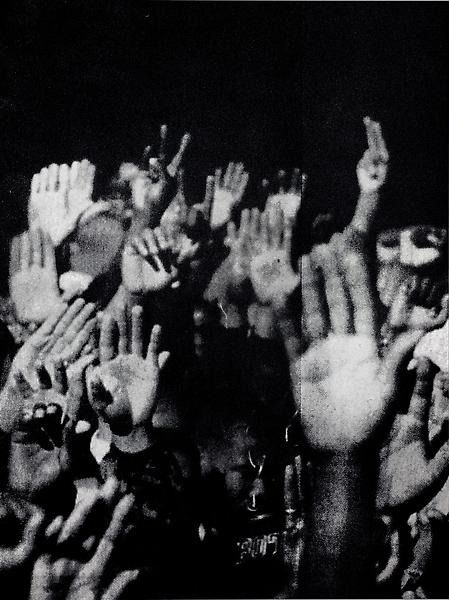
Glenn Ligon, Hands (with detail), 1996

Pinterest


Seeds of inauthenticity start to take root.


Not always the kind you'd notice. Sometimes inauthenticity is loud: borrowing an opinion because it's already popular, wearing a certainty that hasn't been earned yet. But sometimes it's just absence. A version of you that got edited down, quietly, over years, into whatever felt safest not to be misread. Both are the same root, just facing different directions. One reaches outward for someone else's certainty. The other disappears rather than risk being wrong about its own.


In 1817, John Keats wrote a letter to his brothers, trying to describe what he thought separated a truly great mind from a merely clever one. He called it Negative Capability; the capacity to exist, as he put it, "in uncertainties, mysteries, doubts, without any irritable reaching after fact and reason." It's tempting to read that as permission to stay quiet a little longer. But it's closer to something else, not staying silent forever, but staying inside the question long enough to find out what you think, instead of either grabbing the nearest borrowed answer or deciding the question wasn't safe enough to sit with out loud.


That's the part I got wrong, for a long time. I treated my doubt like a reason to disappear, when maybe it was just asking for a little more time.


Because when enough of us go quiet at the same moment, not out of peace, but out of doubt, the room doesn't actually go quiet. Somebody else fills it. Usually whoever was least burdened by uncertainty in the first place, which isn't always the same thing as whoever had the truest thing to say. Call it a gentle kind of sophistry; not because anyone means to deceive, but because a culture made up of quietly unsure people still needs someone to talk, and it tends to reward whoever sounds surest, not whoever's closest to true. You can hear it in how people argue online, where the goal so often becomes not losing rather than being right. You can hear it in the confident, editorial certainty of people who never had to sit with the question at all.


None of this reads like a character flaw, really, in anyone. It's just what happens when self-trust doesn't have anywhere safe to land. Some of us overreach for it, and some of us just go quiet instead, and either way, the honest, half-formed version of what we really think rarely makes it into the room.


Maybe the red thread this time is something like this: doubting a decision is healthy, even necessary. It is supposed to happen, and it usually leads somewhere. Doubting ourselves is more fragile, and left untended, it doesn't just distort what we say. Sometimes it erases whether we say anything at all. If there's an invitation in any of this, it isn't to fix the doubt faster, or to suddenly become loud. It might be smaller than that. Noticing the moment right before you decide it's safer to stay quiet, and asking, gently, whether that's true this time, or just familiar. Letting I don't know yet be spoken instead of just felt. Trusting that the half-formed thought you almost didn't say might be worth more to someone than the silence you were about to choose instead.


Because when enough of us go quiet at the same moment, not out of peace, but out of doubt, the room doesn't actually go quiet. Somebody else fills it. Usually whoever was least burdened by uncertainty in the first place, which isn't always the same thing as whoever had the truest thing to say. Call it a gentle kind of sophistry; not because anyone means to deceive, but because a culture made up of quietly unsure people still needs someone to talk, and it tends to reward whoever sounds surest, not whoever's closest to true. You can hear it in how people argue online, where the goal so often becomes not losing rather than being right. You can hear it in the confident, editorial certainty of people who never had to sit with the question at all.


None of this reads like a character flaw, really, in anyone. It's just what happens when self-trust doesn't have anywhere safe to land. Some of us overreach for it, and some of us just go quiet instead, and either way, the honest, half-formed version of what we really think rarely makes it into the room.


Maybe the red thread this time is something like this: doubting a decision is healthy, even necessary. It is supposed to happen, and it usually leads somewhere. Doubting ourselves is more fragile, and left untended, it doesn't just distort what we say. Sometimes it erases whether we say anything at all. If there's an invitation in any of this, it isn't to fix the doubt faster, or to suddenly become loud. It might be smaller than that. Noticing the moment right before you decide it's safer to stay quiet, and asking, gently, whether that's true this time, or just familiar. Letting I don't know yet be spoken instead of just felt. Trusting that the half-formed thought you almost didn't say might be worth more to someone than the silence you were about to choose instead.


To the big steppas, the loud dreamers, the ones with too many ideas and not enough proof yet— doubt will come looking, especially for the ones building something that didn't exist before you decided to make it. Perhaps here we can take two steps, not two hundred: one to stay a while, and one to keep going once you have. Because maybe the point was never to speak with more certainty. Maybe it was just to trust that the quiet, unfinished version of what you think is still allowed to take up space.


So, are you sure?


Maybe not yet. And that's alright. Let it be your own not-yet, taken gently, rather than someone else's well- argued one.


Pinterest

Pinterest

Glenn Ligon, Hands (with detail), 1996


To the big steppas, the loud dreamers, the ones with too many ideas and not enough proof yet— doubt will come looking, especially for the ones building something that didn't exist before you decided to make it. Perhaps here we can take two steps, not two hundred: one to stay a while, and one to keep going once you have. Because maybe the point was never to speak with more certainty. Maybe it was just to trust that the quiet, unfinished version of what you think is still allowed to take up space.


So, are you sure?


Maybe not yet. And that's alright. Let it be your own not-yet, taken gently, rather than someone else's well- argued one.


Seeds of inauthenticity start to take root.


Not always the kind you'd notice. Sometimes inauthenticity is loud: borrowing an opinion because it's already popular, wearing a certainty that hasn't been earned yet. But sometimes it's just absence. A version of you that got edited down, quietly, over years, into whatever felt safest not to be misread. Both are the same root, just facing different directions. One reaches outward for someone else's certainty. The other disappears rather than risk being wrong about its own.


In 1817, John Keats wrote a letter to his brothers, trying to describe what he thought separated a truly great mind from a merely clever one. He called it Negative Capability; the capacity to exist, as he put it, "in uncertainties, mysteries, doubts, without any irritable reaching after fact and reason." It's tempting to read that as permission to stay quiet a little longer. But it's closer to something else, not staying silent forever, but staying inside the question long enough to find out what you think, instead of either grabbing the nearest borrowed answer or deciding the question wasn't safe enough to sit with out loud.


That's the part I got wrong, for a long time. I treated my doubt like a reason to disappear, when maybe it was just asking for a little more time.


Keep Reading

0%

Keep Reading

0%